TL;DR — the short answer
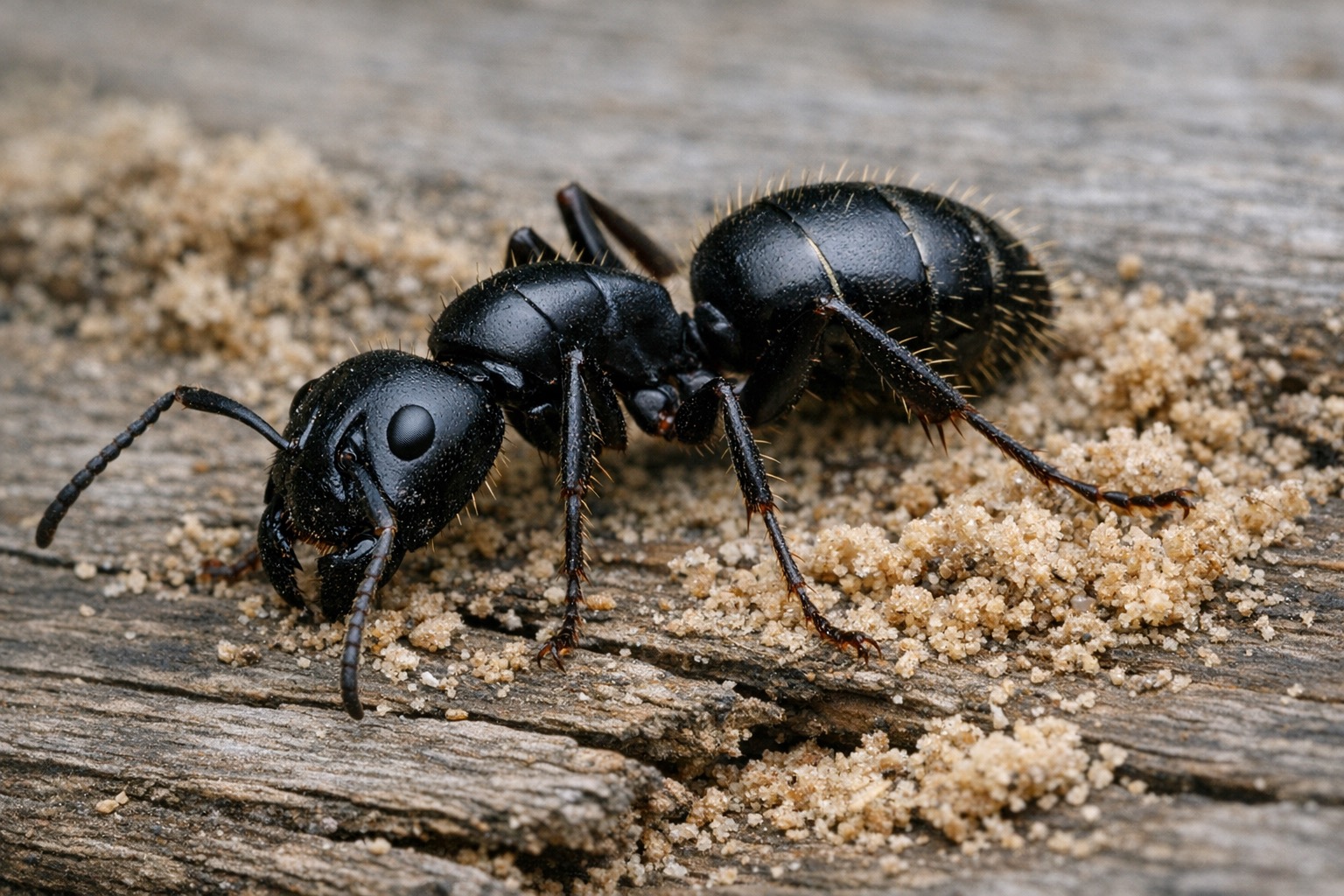
Carpenter ants have elbowed antennae, a pinched waist, and uneven wings; termites have straight antennae, a thick waist, and four equal-length wings. Ants excavate damp wood and leave coarse sawdust-like frass; termites eat wood and pack galleries with mud. Termite damage is faster and costlier — but carpenter ant activity signals a moisture problem you'll want fixed either way.
Updated October 25, 2026 · Written for Northeastern PA homeowners
Telling the Insects Apart
The fastest field check is the waist: carpenter ants have a narrow, pinched waist and elbowed antennae; termites are thick-waisted with straight, bead-like antennae. Swarmers add a wing test — termite wings are equal length and twice the body length, while ant forewings are clearly longer than the hind pair.
Color misleads people: the termites doing the damage are pale, soft-bodied workers that avoid light, while the black insects homeowners see are usually carpenter ant foragers. Termite swarmers are dark, which is why spring swarms get confused — but the waist, antennae, and wing tests hold regardless of color.
| Feature | Carpenter ant | Termite |
|---|---|---|
| Antennae | Elbowed (bent) | Straight, bead-like |
| Waist | Narrow, pinched | Thick, no constriction |
| Wings (swarmers) | Front pair longer than back | Four equal-length wings |
| Color | Black or red-and-black | Workers pale; swarmers dark |
| Debris | Coarse frass (sawdust + insect parts) pushed out of galleries | Mud tubes; galleries packed with soil |
| Damage speed | Slow — years for structural harm | Faster; feeds 24/7, damage often hidden for years |
| Swarm season in PA | April–May | March–May, after warm rain |
| What it signals | Moisture-damaged wood | Any sound wood; soil contact |
How the Damage Differs
Carpenter ants excavate smooth, sanded-looking galleries — usually in damp or decaying wood — and push frass out through small openings. Termites consume the wood itself, leaving ragged galleries packed with mud and soil, a thin surface skin over hollowed framing, and paint that bubbles over hidden feeding.
Frass is the easiest household diagnostic. Piles of coarse sawdust mixed with insect body parts below a window frame or baseboard mean carpenter ants — termites keep their mess inside the wood. Conversely, pencil-wide mud tubes climbing a foundation wall are exclusively termite work.
The moisture connection differs too. Carpenter ants strongly prefer wood already softened by water — a leaking sill, a damp porch post — so their nest location maps your moisture problems. Termites happily attack perfectly sound dry wood as long as they can reach it from soil, which is why their damage so often surfaces only during renovations or real-estate inspections.
Which Is Worse — and What Each Signals
Termites are the bigger structural and financial threat: colonies are larger, feed around the clock, and damage is almost never covered by insurance. Carpenter ants work more slowly, but an established colony still damages porches, window framing, and rim joists — and their presence reliably marks a moisture problem that needs repair regardless.
Penn State Extension lists carpenter ants — see its carpenter ant guide — among Pennsylvania's top structural pests, and its page on eastern subterranean termites covers the species responsible for essentially all PA termite damage. Both are established across NEPA's wooded, older neighborhoods.
A practical rule: carpenter ant infestations often end with a repair list (fix the leak, replace the soft wood), while termite infestations end with a protection plan (treatment plus annual inspections). Either insect indoors this spring deserves identification this week — swarmers mean a mature nest, and mature nests don't shrink on their own.
Found Swarmers? What To Do Now
Save a few insects in a bag or take a sharp close-up photo, note where they emerged, and get a professional identification — it takes a technician seconds and the treatments are completely different. Don't spray the swarm: it kills nothing but the reproductives and leaves the nest untouched.
If the insects are ants, the nest is usually reachable with colony-level baits and non-repellent treatments; our carpenter ant elimination guide covers the process. If they're termites, treatment means a soil barrier or bait system — see how termite treatment actually works before collecting quotes.
Unsure which you have? That's normal, and it's exactly what a free inspection settles. Bring the sample, show the spot, and get the answer in writing.
When to Call a Pro
The moment you find swarmers, frass, or mud tubes indoors. Identification is free and fast, and both insects punish waiting: carpenter ant colonies bud into satellite nests when sprayed, and termite colonies feed year-round. We inspect for both, identify on the spot, and quote the right treatment in writing — ant work and termite work are different services with different warranties.
Professional service
Carpenter Ants control in NEPA
Excavate damp wood to nest — a warning sign of moisture problems in your home.
Professional service
Termites control in NEPA
Silently eat structural wood — damage often appears only after years of feeding.
Free inspection, firm written quote, no pressure. Same-day service available across Scranton, Wilkes-Barre, and the surrounding counties.
Get a Free Quote